
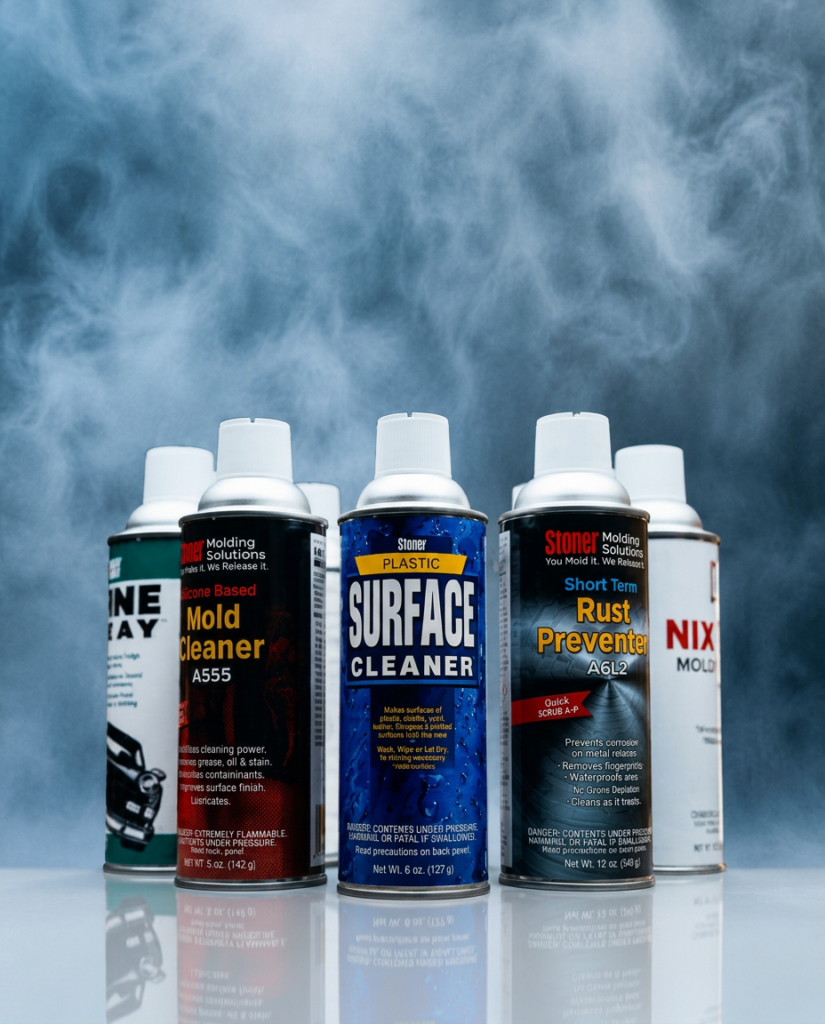
An aerosol label may look simple when it is sitting on a finished can. But behind that finished appearance is a series of decisions that can affect how the label prints, applies and performs.
For aerosol manufacturers, the label is part of a larger production system. The adhesive, substrate, grain direction, dimensions, coatings, colour requirements and application environment all have to work together.
The Label Is Part of the Production System
A label can look perfect when it leaves the printing press and still create problems later if its construction is not suited to the application.
Depending on the product and equipment, poorly matched labels can lift, wrinkle, slide or misapply. On automated filling and labelling lines, dimensional variation can also contribute to misfeeds and jams.
The solution begins with understanding how the label will actually be used.
Before production, important considerations can include:
- What adhesive system will be used?
- How will the label be applied?
- What type of container will it wrap around?
- What temperatures, moisture or chemicals will it encounter?
- How much abrasion or handling will it experience?
- Does the label need a particular level of opacity?
- Are there specific colour or branding requirements?
- Will the label be applied manually or on automated equipment?
These questions help determine the appropriate label construction rather than treating every aerosol label as the same.
Substrate and Grain Direction Matter
The paper or film selected for an aerosol label is more than a surface for printing. It can influence how the finished label behaves during application and use.
For example, Executive Printing’s premium Striking paper is designed to resist moisture-related warping and perform well with hot- and wet-glue applications.
Grain direction is another important consideration. Because an aerosol label needs to conform around a cylindrical container, the direction of the material’s fibres can influence how the label behaves as it wraps around the can.
A label that does not conform properly can be more likely to curl away from the container or create other application issues.
The goal is to select a substrate and construction that work with the physical demands of the application.
Precision Matters on Automated Lines
Consistency from one label to the next is especially important when labels are being applied by automated equipment.
Every label needs to maintain its specified size and shape throughout the production run. Small dimensional variations may become more significant when thousands of labels are being fed through an automated system.
Precise cutting and repeatable production help ensure that the label the filling line receives matches the specification established at the beginning of the project.
That repeatability is one reason aerosol label production should be approached as a manufacturing process—not simply a printing job.
Testing on the Customer’s Equipment
One of the best ways to evaluate an aerosol label is to put it through the environment where it will actually be used.
Application equipment, container dimensions and production conditions can vary from one manufacturer to another. A label that performs well in one application may require a different construction in another.
That is why Aerosol Labels can provide up to 2,000 FREE samples for customers to evaluate on their own equipment.
Testing gives manufacturers an opportunity to see how the label behaves under their actual production conditions before committing to a larger run.
It is a practical step that can help identify potential application issues early.
An aerosol label is a relatively small component of a finished product, but its performance can depend on a surprisingly large number of variables.
The substrate affects how the label behaves.
The grain direction affects how it conforms around the container.
The dimensions affect how it feeds through equipment.
The coating affects how it withstands its environment.
The colour affects how consistently the brand is represented.
The artwork and prepress process affect what ultimately reaches the press.
All of these elements have to work together.
Let’s make your brand stand out, one can at a time. Contact us today!